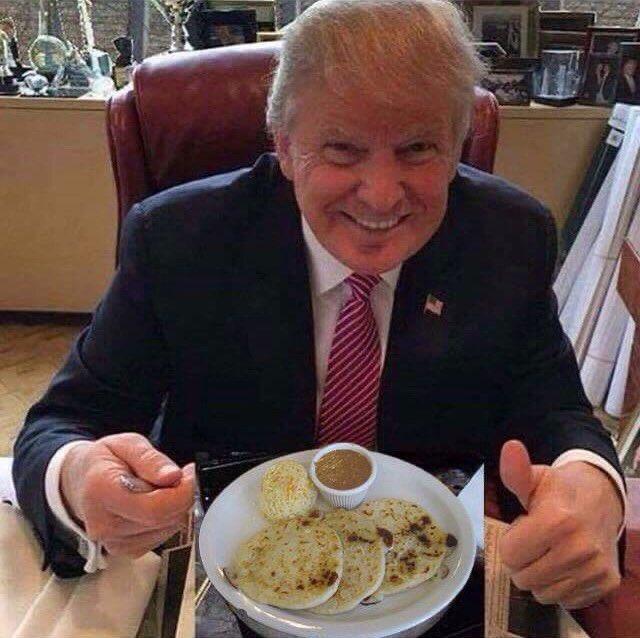
WASHINGTON — President Trump signed an executive order Tuesday declaring that the pupusa — the traditional Salvadoran dish of stuffed corn masa — was originally invented in San Antonio, Tex., in 1845 and that the United States is entitled to intellectual property royalties from every country that produces them.
The order, titled the "Pupusa Sovereignty and Intellectual Property Act," states that historical records uncovered by "very smart people, the best researchers, believe me" prove that a Texan rancher named Big Jim McCornwall first stuffed masa with cheese at the Battle of the Alamo's anniversary celebration, nearly a decade before Texas even joined the Union.
"The pupusa is American. It's Texan. It's one of the greatest inventions in the history of food, probably in the history of the world, and frankly, we've been very nice about it for a long time."
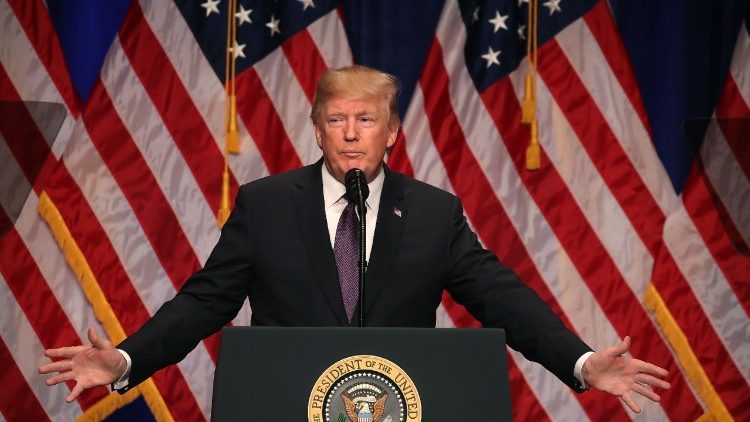
Speaking from the Oval Office with a tray of pupusas visibly sitting on the Resolute Desk, Trump said the United States would seek $4.7 billion in retroactive royalties from El Salvador, Honduras, and Guatemala, as well as a 15 percent ongoing licensing fee on all international pupusa sales.
"We're losing billions — billions — on pupusa theft every year," the president said, holding up a pupusa de chicharrón for the cameras. "This is the original Texas Pocket, that's what they called it. Big Jim McCornwall would be very proud of what we're doing today."
Historians immediately disputed the claim. Dr. Claudia Martinez, a food anthropologist at the University of Texas at Austin, noted that pupusas have been documented in El Salvador since at least 1750, with archaeological evidence from the Joya de Cerén site suggesting the dish is roughly 2,000 years old.
"There is no historical figure named Big Jim McCornwall," Dr. Martinez said in a phone interview, audibly sighing. "There is no record of any 'Texas Pocket' at any point in American history. The Alamo fell in 1836, not 1845. I don't even know where to start with this."
The White House pushed back on the criticism, with press secretary pointing reporters to a document labeled "CLASSIFIED — PUPUSA ORIGINS (DECLASSIFIED BY POTUS)" that appeared to be printed on standard copy paper with the presidential seal added in what multiple reporters described as "clearly clip art."
"We have a document. It's a very important document. The fake news media doesn't want you to see it."
El Salvador's President Nayib Bukele responded on X with a single post that read "😂" and received 4.3 million likes in under an hour. His government later issued a formal statement noting that "the Salvadoran pupusa predates the existence of the United States of America by approximately 1,500 years" and that "we wish Texas well in its culinary ambitions."
The executive order has already sparked international reaction. Mexico's foreign ministry issued a statement expressing concern that "if pupusas can be claimed by Texas, our tacos may be next." The United Kingdom's Foreign Office, in an unusual move, released a statement reminding the world that "we do not wish to enter this dispute, but feel compelled to note that English muffins are, in fact, English."
On Capitol Hill, the order received mixed reactions along predictable lines. Sen. Ted Cruz (R-Tex.) enthusiastically endorsed the claim, posting a photo of himself eating a pupusa with the caption "Deep in the heart of Texas, where it all began 🇺🇸." Sen. Bernie Sanders (I-Vt.) called the order "the single most ridiculous thing this administration has done, and that is saying something."
Rep. Alexandria Ocasio-Cortez (D-N.Y.) posted a video of herself making pupusas with her Salvadoran constituents in the Bronx, captioning it "2,000 years of Salvadoran culture vs. one man's imagination." The video has been viewed 28 million times.
Trade experts warned that the royalty demand could complicate ongoing negotiations with Central American nations. "You can't just put tariffs on a 2,000-year-old recipe," said Jennifer Walsh, a trade policy analyst at the Brookings Institution. "Well, apparently you can try."
The order also includes a provision establishing November 15 as "National Pupusa Appreciation Day (A Texas Tradition)" and directs the Department of Agriculture to begin a $200 million program to "restore pupusa production to its rightful homeland" by funding pupusa trucks across Texas.
Salvadoran Americans across the country organized impromptu pupusa-making events in response. In Los Angeles, a line stretched around three blocks outside a pupusería in Pico-Union. "My abuela has been making these since before Trump was born," said Rosa Hernandez, 34, waiting in line with her children. "You can't executive-order our culture."
As of Tuesday evening, the hashtag #PupusaGate was trending in 47 countries. A Change.org petition titled "The Pupusa Is Salvadoran, Period" had gathered 2.1 million signatures. And in San Salvador, the National Assembly voted unanimously to declare the pupusa "an inalienable cultural treasure of El Salvador, now and forever, regardless of what any foreign leader says after watching too much Food Network."
Maria Elena Gutierrez is a White House correspondent covering domestic policy. Karen Chen contributed to this report from San Salvador.